
Mountains are not mountains
Zen Talk 2013

The Four Noble Truths are a characteristically Indian formula. There are others. Chinese Buddhism felt much more drawn to the formula of the Two Truths. Nagarjuna writes about this: “The Buddha’s teaching is based on two truths: a truth of worldly convention and an ultimate truth. Those who do not understand this difference do not understand the Buddha. Without a foundation in conventional truth, the ultimate cannot be expressed. Without insight into the ultimate, liberation is not possible.” (MKV 214-216)
Volumes have been written about these few sentences. On the one hand, the formula of the two truths fitted much better into the Chinese model of unity and multiplicity. On the other hand, it has caused a lot of confusion.
In response to various scandals involving abuse of power by Buddhist teachers, Stephen Batchelor calls the doctrine of the two truths the doctrinal basis for a two-tier model of authority: those who possess direct knowledge of the ultimate truth on the one hand, and ordinary mortals on the other. The authority of the teacher thus receives a mystical-ontological justification.
In this way, a kind of priestly class has emerged in Buddhism that claims to have direct access to that which ordinary mortals do not have access to. The ordinary mortal thus automatically finds himself in a position of dependence. In the many discussions with Brahmins, which we find in the Pali Canon, we see that the Buddha radically rejected this.
Stephen Batchelor points to this as the Achilles heel of Western Buddhism. For many, this was a huge disillusionment. We had become estranged from the words of the traditions we grew up with. We saw Buddhism as the answer, as the only non-dogmatic, non-irrational, non-violent religion, and thus also the only religion compatible with science and with the autonomy of the individual.
That illusion has now been seriously shaken. One scandal after another is coming to light. Abuse of power and sexual abuse occur in Buddhism just as much as in other religions. In this way, Buddhism is single-handedly dispossessing itself of its long-cherished halo.
The problem is not so much the distinction between ultimate and conventional truth in itself, but rather the unnecessary mystification of it. In some traditions, the idea of the two truths is seen as deeper, more mystical, and superior to the original four noble truths.
There is a well-known Chinese Zen saying attributed to Qingyuan Weixin (9th cent.): “Thirty years ago, before I practiced Zen, I saw mountains as mountains, and waters as waters. Later, when I encountered a true teacher, I had an insight. I saw that mountains were not mountains, and waters not waters. Now, having found a place of rest, I see mountains as simply mountains, and waters as simply waters.”
Paradoxes like this open the door to mystification. The well-known atheist philosopher Daniel Dennett would probably call this a ‘deepity’, that is, profound nonsense. However, while Dennett is passionate about clear, analytical language, the ancient Chinese philosophers were passionate about the layered nature of language.
Can we understand this saying without mystification?
1 The mountain is the mountain
What makes a mountain a mountain? When a skier, a photographer, and a geologist look at a mountain, they will each see a different mountain. What they see stems from their own needs. The skier sees the slopes down which he can speed. The photographer sees the lighting conditions for a good picture. The geologist muses about the extraction of ores and minerals.
In Pali, this is called bhava (becoming). The mountain that I see is not the mountain in itself, it becomes part of my story. At the same time, I become part of the mountain’s story. In this way, both the mountain and the observer acquire their identity. This is conventional reality. It is what we called the discrepancy mode in a previous talk. This brings us into the realm of the first and second noble truths, albeit without the explicit emphasis on suffering.
2 The mountain is not the mountain
When you sit down with the willingness to let go of all wanting and not wanting for a moment, and to put an end to all discrepancies, then every distinction and identity falls away. The mountain is no longer the mountain. On your cushion, you don’t need to know your name. When you get up, you need to know which shoes are yours. But on your cushion, you don’t need to know.
There is no image you have to live up to, no image you fail to live up to. You are perfect, not because all discrepancies have been bridged, but because you no longer create any. As the Prajnaparamita Heart Sutra says, “There is no suffering, no cause of suffering, no cessation of suffering, no path, no insight, no attainment, and no non-attainment.” While the Pali Canon is sparse regarding the third noble truth, the cessation of suffering, the Prajnaparamita Sutras attempt to articulate it and express ultimate reality. You can understand the ultimate reality as an expression of the third noble truth.
3 The mountain becomes the mountain again
When I get up from my cushion, the mountain is the mountain again. I re-enter conventional reality. But it is no longer the same mountain. It is no longer my mountain. No longer caught up in, or let’s be realistic, less caught up in my story, more open to the other, more creative, more open to the stories of others, with more compassion, I am ready to step into the world, to be human, to be a fellow human being, and to live. This brings me back to the path, the fourth noble truth.
Neither the conventional nor the ultimate is superior to the other. Without awareness of ultimate reality, our lives become hellish, filled with unfulfillable needs. But from the ultimate perspective, you cannot safely cross the street. Then there is no street, no other side, no car, no loud bang, no bleeding to death on the street, and no foolishness.
So there is no such thing as direct knowledge that ordinary mortals cannot access. No exotic “enlightenment” that justifies authority, but rather an ever-increasing trust, openness, and compassion for all living beings.
Joko Beck calls it ‘nothing special’. It is my experience that almost everyone in the world, even if only in an intimate longing, knows about this. In Japanese Tendai, the crucial moment of realization is in knowing this and being able to name it. Sometimes, this realization only amounts to a vague intuition of “something”.
Established religions sometimes disparage this as “somethingism”. However, there is nothing to be dismissive about. It is almost criminal to ignore this longing for “something” and to place authority in the hands of a professional priesthood. On the other hand, if we get no further than “something”, and cannot find recognizable words, then all kinds of abuse will have free rein.
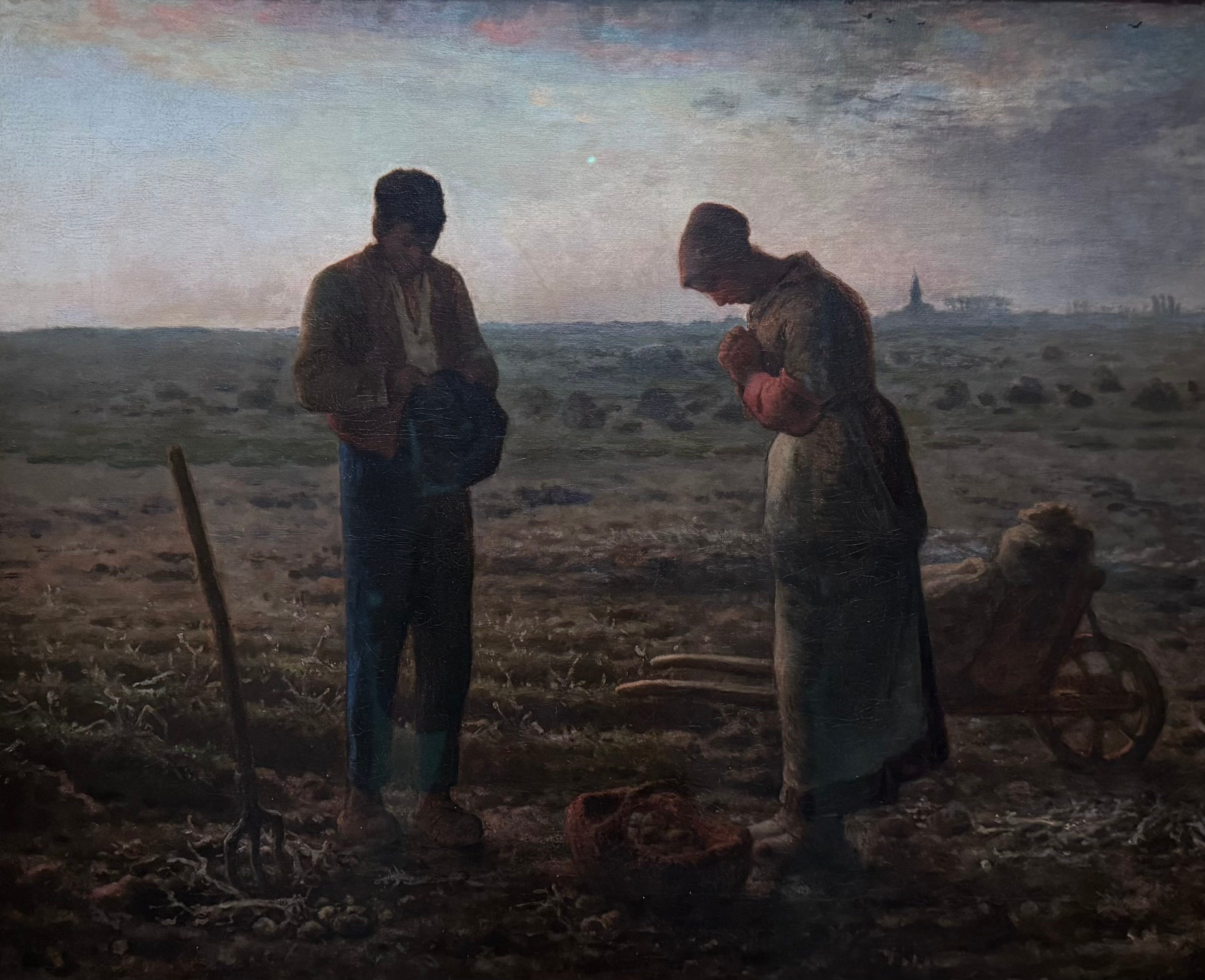
When the Japanese Zen teacher Hisamatsu was asked whether he could also find the spirit of Zen in Western art, people showed him all kinds of artwork. One touched him most deeply: Millet’s Angelus. It depicts two figures in the countryside, a farmer and a farmer’s wife, praying with their hands folded. In the distance, a village with a church tower that has just rung the Angelus. What inspired a Japanese Zen teacher, rebel, and founder of an anti-authoritarian lay movement to choose this particular scene?
Two people with hard lives, working the land without any form of security. Perhaps the harvest will fail and they will face famine next year. Perhaps she is pregnant and will die in childbirth in a few months. There is no misplaced romanticism here. Amidst their scarcity in which they must survive, there is that brief moment of “Ave Maria, gratia plena”, “Hail Mary, full of grace”. In the midst of scarcity, there is a brief moment of plenitude where “more” does not apply.
We all know this. Everybody knows. Genpo Roshi once compared tradition to a container: it preserves and, at the same time, conceals. The difference here is that the expiration date applies to the packaging, not the contents. We urgently need new packaging. We urgently need to find new words. It’s simply a matter of life and death.
Thank you, Edel, to share this talk. 'Proofs' for me that something thought, shared, created in the space that we call the past now can be very vibrant and worthwhile in the now. I was a teacher for 40 years and always struggled with the mantra: teacher knows, student knows not. Sometimes I have the feeling that 'western buddhism' is 80% western and 20% buddhism.